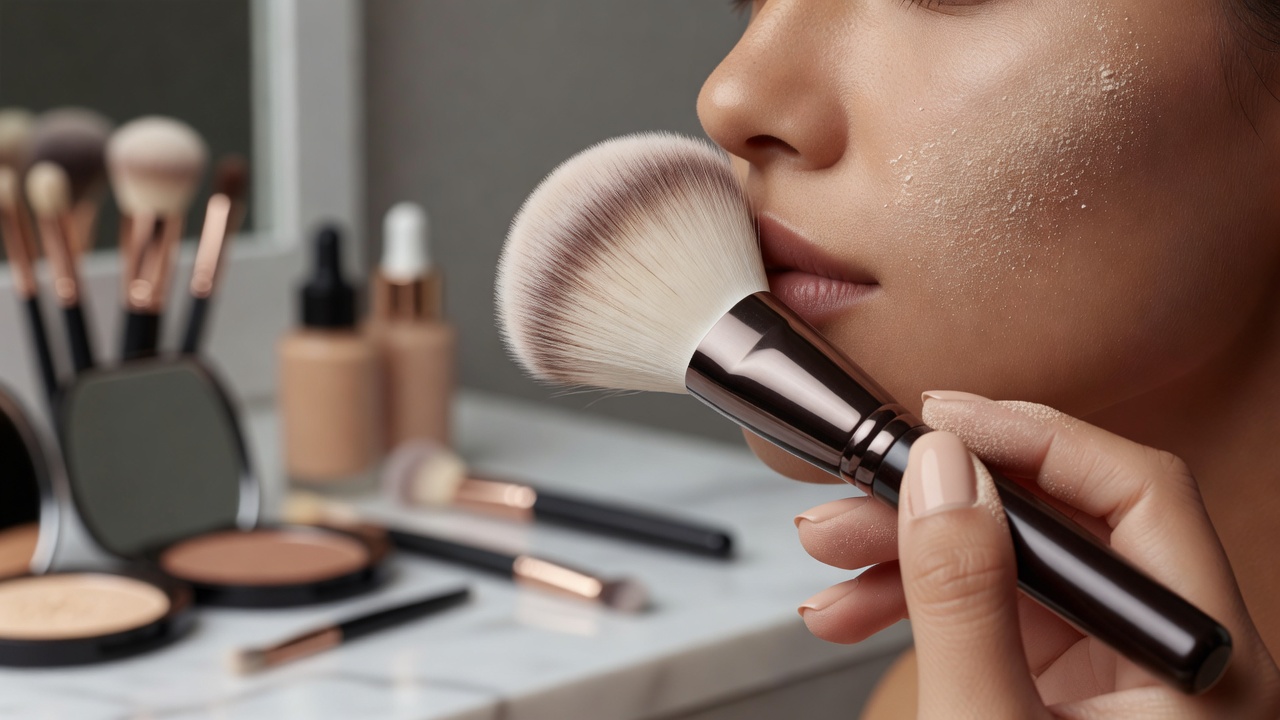
A tutorial asks you to follow a process, yet a short video often gives its most generous attention to the finish. The camera moves closer, the music changes and the creator turns toward a flattering light. None of this makes the video dishonest. It does mean that your first task is to identify what was actually demonstrated. Watch once for the overall idea, then again for the sequence. Treat the second viewing as observation rather than evaluation.
Establish the starting frame
Before following the first visible action, ask what is already present. Is the face bare, partly finished or prepared off camera? Are brows, lashes and complexion products already in place? A missing preparation step may explain why your result differs even when your hand movement looks similar. Write “not shown” rather than guessing. A useful observation record distinguishes a visible fact from a plausible interpretation.
The crop matters too. A close-up may teach the angle of a brush while hiding the direction of the creator’s light. A wider shot may reveal the setup but make small placement changes difficult to see. There is no single correct framing choice. The question is whether that choice provides enough information for the lesson being offered.
Read light before reading coverage
Light direction affects the shadows you can see; softness affects how abruptly those shadows change. A frontal source can make some texture less conspicuous, while a side-lit frame may emphasize surface variation. Exposure and white balance can also change the appearance of brightness and color. Cambridge in Colour’s photography tutorials explain these underlying image-making principles. They are useful here because makeup footage is still footage.
Do not jump from “the lighting changed” to “the product does nothing.” That conclusion also exceeds the evidence. Instead, narrow the claim: the comparison does not isolate the product’s contribution. If a creator shows both stages with the same framing, light and camera settings, the comparison is easier to interpret, although it remains a demonstration on one person.
Follow continuity, not just chronology
- Locate the action. Identify where the tool first touches and where the product is moved. Pause if necessary; speed is not a test of your competence.
- Notice the transition. A cut can hide blending time, another layer or a correction. A time-lapse compresses duration even when the order is preserved.
- Check the next frame. Look for changes in product amount, edges or completed areas. Record uncertainty without turning it into an accusation.
- Restate the lesson. Describe the method in one ordinary sentence. If you cannot, the video may function better as inspiration than instruction.
YouTube’s own help materials describe trimming and cutting video. Instagram and TikTok likewise provide tools for producing edited short-form content. Editing is routine communication, not proof of deception. Its instructional cost appears when an omitted interval contains the very action a beginner needs to learn.
Separate observation from explanation
| What you can observe | What it does not establish |
|---|---|
| The finished cheek appears brighter. | That one product alone caused the change. |
| A brush moves outward from the center. | The pressure applied or exact amount used. |
| The caption says “no filter.” | That lighting, exposure or other processing had no effect. |
| The routine takes thirty seconds on screen. | That application took thirty seconds in real time. |
The most constructive question is often specific: “Could you show the blending stage at normal speed?” That request is more useful than demanding a vaguely “real” video. Creators can improve an explanation by including a neutral overview, naming off-camera preparation and distinguishing elapsed time from screen time. Viewers can improve their own practice by choosing one clearly shown action instead of copying an entire edited routine.
A small viewing glossary
- Exposure
- The image’s recorded brightness, influenced by camera settings and available light.
- White balance
- A camera adjustment affecting how color is rendered under different light sources.
- Continuity
- The apparent consistency of an action or scene across shots. Consistency can support understanding without proving that nothing was omitted.
Sources & further observation
- Cambridge in Colour: portrait lighting — direction and quality of light.
- Cambridge in Colour: white balance — color rendition.
- YouTube Help: trim your videos — editing functions, not evidence about any particular creator.
- Instagram Help Center and TikTok: creating videos — platform tools and documentation.